
Williamson County Release Date Types
A projected release date is a calculation made before confinement ends. TDCJ defines its Projected Release Date as the date calculated by Classification and Records on which a prisoner is expected to leave incarceration if not paroled sooner. It can move. A parole eligibility date marks when review may first occur, while a next review date can follow a denial. Maximum expiration is the sentence endpoint in the state calculation. None is the same as the actual time a person passes through release processing.
For a Williamson County Jail detainee awaiting trial, the premise is different. There is normally no sentence from which to calculate a projected date. Bond may be posted or a personal bond granted, but identity checks, bond acceptance, court paperwork, and other holds can still affect departure. A person serving a sentence in Williamson County Jail does have a term, though the judgment, jail credit, conduct credit, and sheriff’s calendar record must be read together.
Note: A date on a court order may precede physical release because the custodian still must process the order and check every hold.
Find Williamson County Release Dates
The correct lookup depends on whether the person is in Williamson County, state, federal, or immigration custody. Williamson Judicial Records can show the local case and related jail inquiry. TDCJ is the correct source after state intake or for Bartlett Unit. BOP, USMS, and ICE remain separate. A person can move from one system to another on the same day, so the record must identify the next custodian as well as the date Williamson County custody ended.
- Search Williamson County Judicial Records by exact name and booking number when available. Match the cause, charge, bond, judgment, sentence, and docket events.
- Use the Williamson County Sheriff’s Office Corrections Bureau route or call Williamson County Jail at 512-943-1365 for present custody. For an exact historical release, request incarceration verification and the booking or release transaction.
- For a sentence in Williamson County Jail, obtain the signed judgment, pre-sentence credit, commitment, and the sheriff’s conduct or calendar calculation. Do not assume the maximum statutory credit was granted.
- If Williamson County Sheriff’s Office shows a TDCJ transfer, use the TDCJ offender search. Match TDCJ or SID number, age, offense, county, sentence, location, and status.
- Read Projected Release Date, parole eligibility or review, and maximum expiration as distinct fields. Record the day the result was viewed.
- When the online state result is missing or unclear, use TDCJ’s no-charge email information route with the identifiers and fields requested by the agency.
A complete Williamson County named-person search, including the booking-record fallback, is available through the Williamson County released-inmate records route.
Williamson County TDCJ Date Fields
The statewide offender system applies to TDCJ confinement and supervision, not an ordinary bond release from Williamson County Jail. A person transferred after a Williamson felony sentence may take time to appear while state intake is processed. During that gap, the Williamson County Sheriff’s Office transfer record supplies the destination. Absence from Williamson County Jail plus absence from TDCJ does not establish community release.
| Field | What it means | What it does not prove |
|---|---|---|
| Projected Release Date | TDCJ’s current Classification and Records estimate for leaving incarceration if parole does not occur first | A guaranteed physical exit date |
| Parole eligibility or review | The point or cycle at which discretionary review may occur | Approval or release |
| Next review date | A later review point after panel action such as denial | The sentence endpoint |
| Maximum expiration | The calculated sentence endpoint in the state record | Freedom from every other case or hold |
| Location and status | Whether the person is at a unit or shown on a state supervision path | The exact door-out time |
The official TDCJ search form exposes the state lookup route used after a Williamson County commitment.
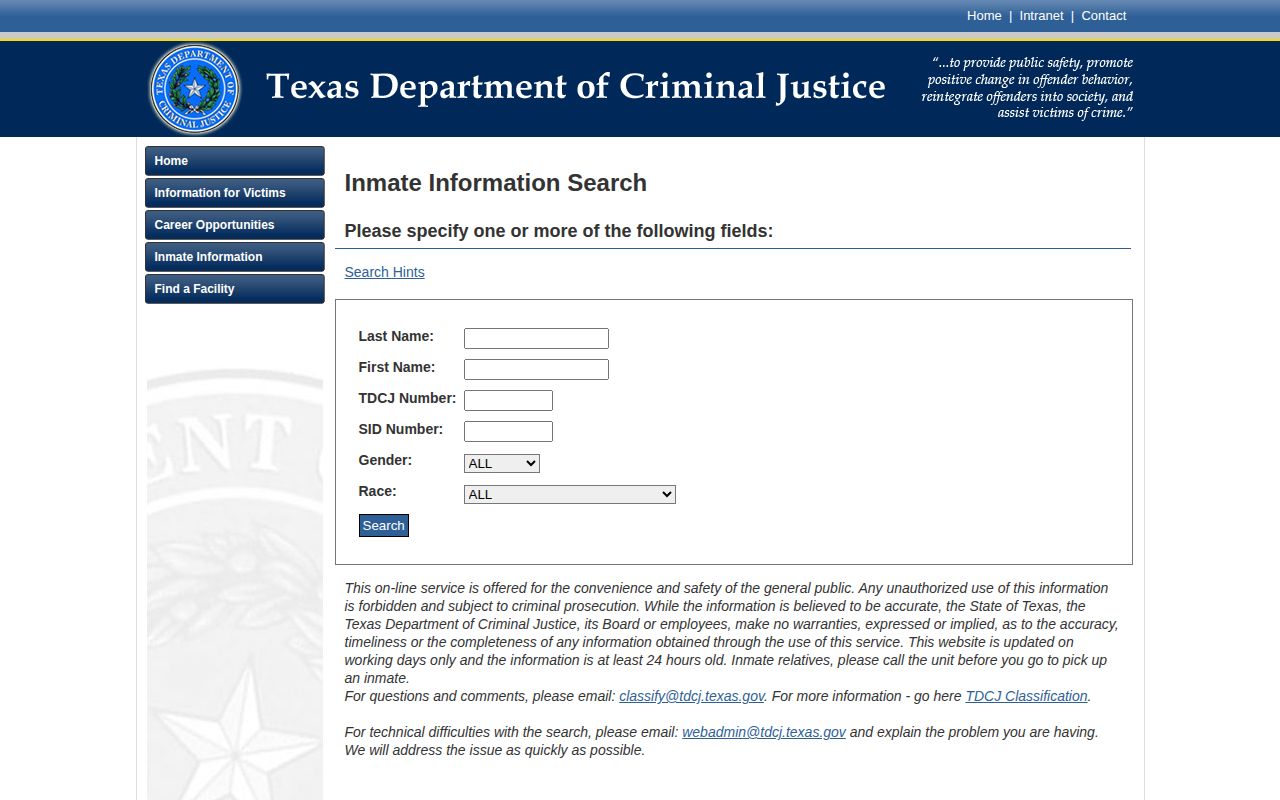
The form is a state-prison tool. County booking and bond-release dates still come from Williamson County Sheriff’s Office and the Williamson County court record.
Williamson County Jail Date Calculation
A Williamson County Jail sentence calculation starts with the judgment. Texas Code of Criminal Procedure Article 42.03 requires qualifying credit for pre-sentence confinement. Article 42.032 then authorizes a sheriff to grant commutation for good conduct, industry, and obedience, with a deduction that may not exceed one day for each day of the original sentence actually served. Misconduct may forfeit accrued commutation, and the sheriff must keep a conduct and calendar record.
The key word is “may.” The statute does not establish an automatic maximum award for every Williamson County sentence, nor does it prove a blanket two-for-one policy. Ask Williamson County Sheriff’s Office for the individual conduct or calendar calculation and compare it with the court’s commitment and jail credit. A docket entry may show the judgment without displaying the sheriff’s later administrative calculation.
No official Williamson County source establishes a fixed daily release batch or automatic early departure before a weekend or holiday. The jail operates continuously even when clerk counters are closed. If a nominal completion date falls near a closure, call the jail and court for the case-specific process. Never move a date on a calendar based on custom from another county.
No Universal Texas 85% Rule
Texas does not require every TDCJ prisoner to serve 85 percent of a sentence. That simple claim imports federal shorthand into a state system that uses offense dates, offense categories, calendar-time floors, good-conduct classifications, parole review, and mandatory-supervision exclusions. A Williamson County sentence can also be a county-jail term under a different statute, which makes a universal percentage even less accurate.
Texas Government Code Chapter 498 governs TDCJ good-conduct time. Section 498.003 describes classifications and possible diligent-participation credit, while Section 498.004 addresses forfeiture and restoration. The statute treats good-conduct time as a privilege rather than a right. It affects eligibility as the law provides and does not simply erase part of every sentence.
Government Code Chapter 508 supplies the parole and mandatory-supervision framework. Section 508.145 contains offense and date-specific eligibility rules. Section 508.149 excludes listed offenses and categories from mandatory supervision. Article 42A.054 also identifies offenses or findings tied to stricter treatment. Consecutive sentences, deadly-weapon findings, sex-offense provisions, life sentences, and the law in force for the case can alter the result.
Federal law may yield an approximation near 85 percent when maximum federal good-conduct credit applies. That federal math does not become a Texas truth-in-sentencing rule. The controlling Williamson County answer comes from the judgment and Williamson County Sheriff’s Office calculation for a county term, or the current TDCJ detail for state imprisonment.
Williamson County State Release Math
TDCJ Classification and Records combines the sentence data with the rules that apply to the individual case. For some mandatory-supervision-eligible offenses committed before September 1, 1996, flat time plus good time reaching the sentence can produce a scheduled route if parole has not occurred first. For eligible offenses on or after that date, BPP discretionary approval is required. A denial may shift the displayed projection to maximum expiration. Noneligible cases generally follow maximum expiration unless parole occurs sooner.
Parole eligibility is its own calculation under Section 508.145. Some cases use calendar time plus good-conduct time, while listed offenses carry stricter calendar-time requirements and minimums. A favorable parole vote still is not the physical release date. Review and Release Processing may need an acceptable plan, imposed conditions, program completion, and a release certificate before the prisoner leaves the unit.
The TDCJ email information page gives the official projected-date definition and a no-charge fallback. Send the full name and seven-digit TDCJ number. If that number is unknown, TDCJ requests exact date of birth or approximate age and county of conviction. Ask for location, current or prior incarceration, offense and court or county, plus Projected Release Date.
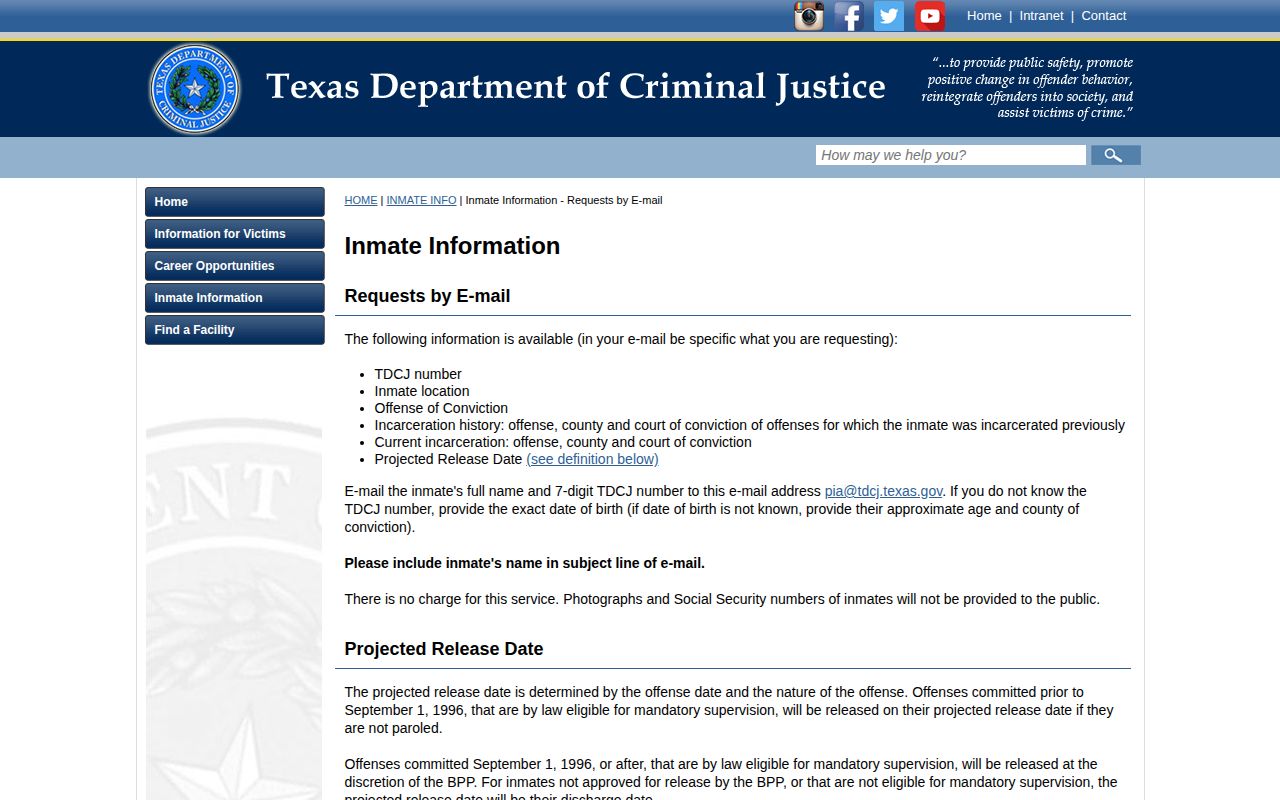
The captured state page reinforces that the field is a projection maintained by TDCJ, not a promise that no later event will change it.
Note: TDCJ’s simple email service does not provide photographs or Social Security numbers, and its release-date response remains tied to state custody.
Williamson County Release Date Changes
A date can move for reasons that arise in the sentence, the custody record, or release processing. The change may make the estimate earlier or later. When two sources conflict, preserve each displayed date and the time it was checked. Then ask the custodian to identify the source of the revision rather than choosing the date that seems most plausible.
| Factor | Possible effect | Record to check |
|---|---|---|
| Corrected jail credit | Changes time already credited toward the sentence | Judgment, commitment, and Classification and Records data |
| Sentence amendment or appeal | Changes the term or legal basis used in the calculation | Signed court order and updated agency record |
| Concurrent or consecutive construction | Changes whether multiple terms overlap or follow one another | Judgments and TDCJ sentence record |
| Good-time class, loss, or restoration | Changes applicable eligibility or projected timing | Williamson County Sheriff’s Office conduct calendar or TDCJ time record |
| Detainer or new sentence | May prevent community release or send the person to another custodian | Release transaction and receiving-agency field |
| BPP action or required program | Can approve, deny, delay, rescind, or condition the state release path | BPP result, vote code, and release-processing status |
A detainer is a request or legal basis for another agency to hold or receive the person. It explains why an end date in one system may lead directly to custody in another. Discharge means the sentence at issue has ended. Neither term should be inferred from a missing name.
Note: Preserve each displayed calculation date because a later correction may be valid even when the earlier Williamson County result was accurate.
Confirm Williamson County Actual Release
For Williamson County Jail, obtain the dated Williamson County Sheriff’s Office book-out or release transaction through the official public-information channels. It should be matched to the court authority and should identify a receiving agency when the event was a transfer. For Bartlett Unit or another state prison, read TDCJ status and release information after processing. If state supervision follows, confirm the assigned district parole office. A court or county CSCD record is the source for probation, while Pretrial Services covers assigned bond supervision.
VINELink can provide a participating county custody event, and TDCJ IVSS offers a state custody and parole notification layer. Those services push useful alerts, but neither is the certified release record. BOP and USMS cover federal criminal custody. ICE covers immigration detention. A Williamson County Sheriff’s Office handoff to one of those agencies is not a release to the community.
For an expected event, registration before the date makes a notification more useful. The Williamson County VINE check explains the local and state notification layers. After an alert, note its timestamp, read any transfer wording, and confirm the destination with the agency that processed the event.
The final answer should identify three facts: the legal authority, the completed custody transaction, and the next custodian or supervision system. “Gone from the roster” supplies none of them by itself.