
Verify Williamson County 72-Hour Releases
Williamson County has no official 72-hour release feed. The Sheriff’s Office links to Judicial Records, which is searched by a person’s first and last name or booking number. Williamson County does not state that this inquiry is a release-only endpoint. It also publishes no rolling three-day window, update cadence, or fixed post-release display term. The correct three-day result is therefore a set of verified individual events, not a county-certified browse list.
Start by defining the period. Record the current local date and time, then count back 72 hours. Every claimed release needs a Williamson County Sheriff’s Office book-out time that falls inside that span. A court order signed during the period may explain the authority, but it does not prove when jail processing ended. A VINE notice can help locate an event, though its transmitted time may differ from the physical exit. Compare each source without forcing the timestamps to match.
Build Williamson County’s Three-Day Window
A 72-hour search is partly historical. Live status matters, but the court case and retained jail record deserve more weight than they do in a same-hour check. Keep a simple timeline for each person. Record when the jail search was run, the booking identifiers, the court action date, any VINE event time, and the final Williamson County Sheriff’s Office book-out time. If the destination was another agency, add that agency’s first confirmed custody event.
- Search Williamson County Judicial Records by exact name or booking number. Match the charge, booking date, and cause number before using a result.
- Call the Williamson County Jail at 512-943-1365. Ask whether the person remains there and whether the end of county custody was a community release or transfer.
- Use the Williamson County Sheriff’s Office incarceration-verification route at 512-943-1300 for the public verification available by phone. Follow the current records prompt.
- Read the criminal docket. The District Clerk holds district-court felony material, while Williamson County Clerk holds official misdemeanor records.
- Review a pre-registered VINELink alert if one exists. Confirm its release or transfer event with the originating or receiving agency.
- Request the booking sheet and release transaction when the event cannot be fixed to the three-day period from the available sources.
The Williamson County 24-Hour Releases process gives a tighter same-day method when the event is still fresh. The broader window here is meant to recover releases after time has passed.
Note: Search by booking number when available because one person may have several bookings or several causes tied to one jail stay.
Williamson County Three-Day Record Fields
Official county documentation does not promise that Judicial Records displays every release field. It may preserve booking and case data after the live custody episode, which makes it useful for the 72-hour reconstruction. Still, the Williamson County Sheriff’s Office booking sheet or jail-history transaction is the more direct source for when county custody ended. Ask for the public fields that answer a precise release question.
| Field | Role in a 72-hour review |
|---|---|
| Full name and aliases | Starts identity matching, but should be paired with unique booking or case data. |
| SO or booking number | Separates the relevant jail episode from older or later bookings. |
| Book-in and book-out times | Places the custody episode and its end on the three-day timeline. |
| Release code and authority | Connects the jail action to bond, dismissal, time served, sentence completion, or another order. |
| Case, charge, and hold data | Shows why one resolved cause may not have ended all custody. |
| Destination or receiving custodian | Distinguishes a community exit from transfer to TDCJ, another county, federal authorities, or ICE. |
These fields also prevent date errors. An order date, data-entry date, VINE event time, and physical book-out time are not interchangeable. The three-day determination should use the actual custody transaction while retaining the court order as the legal explanation. If a source lacks a time-zone legend, record that limit rather than assuming one.
Williamson County Search, Not Gallery
The local release architecture favors case continuity. The Williamson County Sheriff’s Office Corrections Bureau sends the public to a combined jail and Judicial Records inquiry. That design helps locate a named booking and its connected case, but it does not provide a county-made gallery of everyone who left in the prior 72 hours. Scraping names that disappear from a current list would discard the release type, next custodian, and proof of timing.
The sheriff’s official page visibly provides the Search Jail Records route used to begin this process:
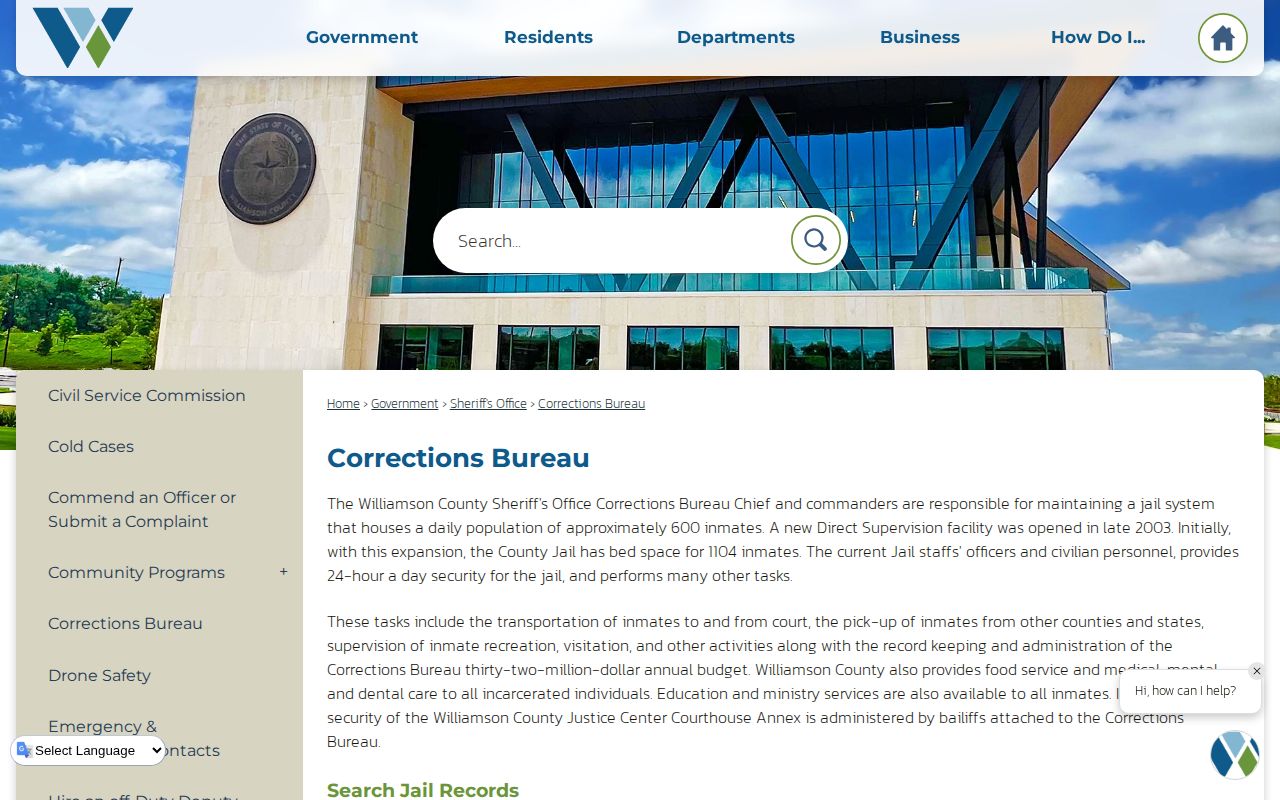
That link identifies Williamson County’s official entry point. It does not convert the destination into a rolling release feed. Search one person, preserve the booking and cause numbers, and move to the Williamson County Sheriff’s Office transaction for the dated result.
Williamson County also publishes no promise that released bookings remain online for 72 hours. Public display and legal retention are different. Texas record schedules depend on the record series, and a retained record can exist after an interface changes. For a three-day inquiry, request that record instead of treating a blank screen as a purge or release.
Williamson County Weekend Release Timing
A 72-hour span often crosses days when clerk counters are closed. The Williamson County Jail operates continuously, while court and records-office access can follow different schedules. Research found no official policy promising that weekend or holiday releases occur in a fixed batch, appear online at a set time, or receive an early processing date. A rolling calculation must therefore use the jail transaction, not assumptions based on office hours.
Begin with the last known booking status. Look for a bond, dismissal, judgment, or time-served action in the docket. Then ask Williamson County Sheriff’s Office for the exact book-out date and time. A judge may sign an order before the jail finishes identity checks, bond acceptance, property return, and review of other holds. Those steps can move the actual custody end into a later calendar day without changing the court’s earlier order.
After three days, VINE works best when the person was registered before the event. A past alert can mark a release or transfer report, but VINELink is not a certified discharge record. If no alert was set, search may still return a supplied custody status. Either way, pair it with Williamson County Sheriff’s Office. The court case is durable evidence of authority; the booking sheet gives the stronger historical time.
Note: A weekend or holiday does not create an official Williamson County release window, batch time, or presumed early-release rule.
Reconstruct Williamson County Older Releases
When the three-day period has already passed, call for incarceration verification and follow with a focused written request. The Williamson County Sheriff’s Office public-information instructions allow submission through the current designated email, fax, mail, or hand delivery. Ask for the booking sheet, book-in and book-out date and time, release authority or type, holds shown at release, and destination if the person was transferred. Include the full name, booking or SO number, approximate booking date, and case number.
Williamson County Sheriff’s Office does not quote one flat release-record fee on the instructions page. Ask for electronic delivery and a cost estimate. The agency describes prompt action under the Texas Public Information Act and a ten-business-day framework for production, a production-date notice, an Attorney General ruling request, or reliance on prior authority. That is an action framework, not a fixed delivery promise.
The court side is split by jurisdiction. Williamson County District Clerk records cover district-court felony matters. County Clerk records cover official misdemeanor matters. Search the proper custodian for the filed bond, dismissal, judgment, sentence, or later order. A court record can persist long after a live jail status changes, though it may not show the exact release time. Pair it with the Williamson County Sheriff’s Office response.
Note: A retained court file explains release authority, while the jail transaction supplies the book-out time needed for a three-day check.
Separate Custody Systems After Release
A Williamson County book-out does not always mean freedom from custody. If Williamson County Sheriff’s Office delivered the person to TDCJ, the Williamson County Jail episode ended and state confinement began. Search the TDCJ offender system after intake, using a TDCJ or SID number when known. A unit location means confinement. Parole or mandatory supervision reflects a state-prison release path. An ordinary Williamson County bond release may never appear in TDCJ.
Federal and immigration custody require different routes. A sentenced federal case may appear in the BOP locator. Some federal pretrial movements remain with the U.S. Marshals Service and may not yet appear as a sentenced BOP record. If Williamson County Sheriff’s Office shows an immigration detainer or handoff, use the ICE detainee locator and ERO contact path. A missing ICE result also does not prove community release.
- Community release
- County custody ended and no receiving custodian is shown, subject to any court or supervision terms.
- Transfer
- One agency ended its custody by delivering the person to another custodian.
- Parole
- TDCJ confinement ended conditionally while state supervision continues under the parole system.
- Discharge
- The identified sentence or supervision term ended, though unrelated matters may still exist.
Williamson Judicial Records and Williamson County Sheriff’s Office confirm Williamson County-jail episode. TDCJ confirms Texas prison custody or state parole and mandatory supervision. County courts, CSCD, and Pretrial Services confirm probation or bond supervision. BOP or federal court sources address federal custody, while ICE addresses immigration detention. VINE supplies event notice across participating systems but does not replace any agency’s official transaction.
For one person, the final three-day record should state what ended, when it ended, why it ended, and where the person went next. If any of those points remains unknown, describe the gap. Do not turn a search absence into a release claim.