
Bartlett Unit Release Paths
Bartlett Unit is a Texas Department of Criminal Justice state prison in Region IV. It is not the Williamson County Jail. A person at Bartlett has entered the state correctional system, so county Judicial Records is the wrong tool for current location or a state release. Use TDCJ’s offender information channels and, when parole is involved, the Texas Board of Pardons and Paroles record.
Leaving Bartlett Unit can mean transfer to another TDCJ unit, release on parole, release on mandatory supervision, or discharge at sentence completion. Only the last three may involve departure from prison confinement, and parole or mandatory supervision continues under TDCJ authority. A unit transfer is continuous custody. The receiving unit and current TDCJ location should replace Bartlett Unit in the person’s record after processing.
A favorable parole vote is not a physical release. An approved plan, conditions, required programming, release certificate, and final processing may remain. Discharge is different from parole because the identified TDCJ sentence has ended rather than continuing under that sentence’s state supervision. If WCSO sent the person into state custody, the Williamson County Jail record can confirm that earlier transfer, but it cannot prove the later Bartlett release.
Search Bartlett Unit Release Status
The TDCJ offender search is the primary public lookup. Prefer the unique seven-digit TDCJ number or state identification number. If neither is known, search by surname and given name, then use the narrowing fields offered by the interface. Match age or date information, sex, race, offense, county of conviction, sentence, and identifiers before relying on the result.
- Search with the TDCJ or SID number when possible. Otherwise use the full name and available narrowing fields.
- Open the matching detail and record the TDCJ number, SID, location, current status, offense, sentence, and conviction county.
- Capture the Projected Release Date, parole eligibility or review information, and maximum-expiration data shown.
- Read location with status. Bartlett Unit or another named unit indicates confinement, even if a future date or favorable vote appears.
- For parole review, use the BPP result route or status line with the name, TDCJ-CID number, and date of birth.
- Confirm actual release through updated TDCJ status and release information, then identify the assigned parole office if supervision continues.
If a recent county-to-state transfer has not appeared, confirm the destination with WCSO and allow for TDCJ intake processing. A lack of a state result does not prove release. The Williamson County custody search path helps trace the event from the county booking to the correct receiving system.
Note: Williamson County as the conviction county does not mean the person is housed at Bartlett Unit or anywhere else in Williamson County.
Bartlett Unit Release Record Fields
A Bartlett Unit result needs more than a date. TDCJ calculates and displays several fields with different meanings. Read the full record and date the observation, since status, location, review data, and projected dates can change. Do not collapse a parole eligibility date, next review date, projected release date, maximum expiration, and completed release into one promise.
| Field | What it means for Bartlett Unit |
|---|---|
| TDCJ and SID numbers | Unique identifiers used to match the state record and request more information. |
| Location and status | A named unit supports current confinement; parole or mandatory supervision reflects release from prison under state supervision. |
| Projected Release Date | TDCJ’s calculated prison-departure date if parole does not occur sooner, subject to later change. |
| Parole eligibility or review | Shows when review may occur or its stage, not a guaranteed physical release. |
| Maximum expiration | The sentence endpoint used in the state calculation, subject to the full record and other cases. |
| Release category and date | Distinguishes parole, mandatory supervision, or discharge when the state record supplies the completed action. |
A BPP favorable vote may precede actual release by plan review, program completion, conditions, and certificate processing. Pair the vote with TDCJ’s later status. If a person moves to another unit, update the location but do not label that movement release. The state record, not a county roster, controls the Bartlett Unit custody question.
Bartlett Unit Projected Release Date
TDCJ defines Projected Release Date as the date calculated by its Classification and Records Office when a prisoner is expected to leave incarceration if not paroled sooner. It is a forecast inside the state sentence framework. It is not a fixed appointment, an approved parole date, or proof that release occurred. The actual event must appear in later state status or release information.
The date may change due to corrected pre-sentence confinement time, a sentence amendment or appeal, concurrent or consecutive sentence construction, a new detainer or sentence, good-time class changes, forfeiture or restoration, a BPP decision on mandatory supervision, parole processing, required programming, or data correction. Government Code Chapter 498 treats good-conduct time as a privilege under the statutory scheme. It does not shorten every sentence in the same way.
Texas also has no universal rule that every state prisoner serves the same percentage of a sentence. Parole eligibility and mandatory-supervision treatment depend on offense, date, findings, and applicable law under Government Code Chapter 508. A projected date can move to maximum expiration after a mandatory-supervision denial. Avoid applying federal good-time shorthand to a Bartlett Unit sentence.
- Projected release
- TDCJ’s current calculated date if no earlier parole occurs.
- Parole eligibility
- The point at which consideration may occur, not a promise of approval or release.
- Mandatory supervision
- A statutory or discretionary supervised release path governed by the person’s eligibility and BPP action.
- Maximum expiration
- The sentence endpoint shown in the state calculation.
Note: Save the date and time of each TDCJ check because a correct projected field can later change for a lawful reason.
Bartlett Unit Is Active Again
Older search results can mislead. Bartlett State Jail closed during its former private-operating era in 2017, but TDCJ has reopened the property as Bartlett Unit. The current TDCJ Bartlett Unit directory lists an active Correctional Institutions Division prison. The live official directory should control over stale pages that still call the site closed.
The current unit record gives the identity and operating facts used for a release search:
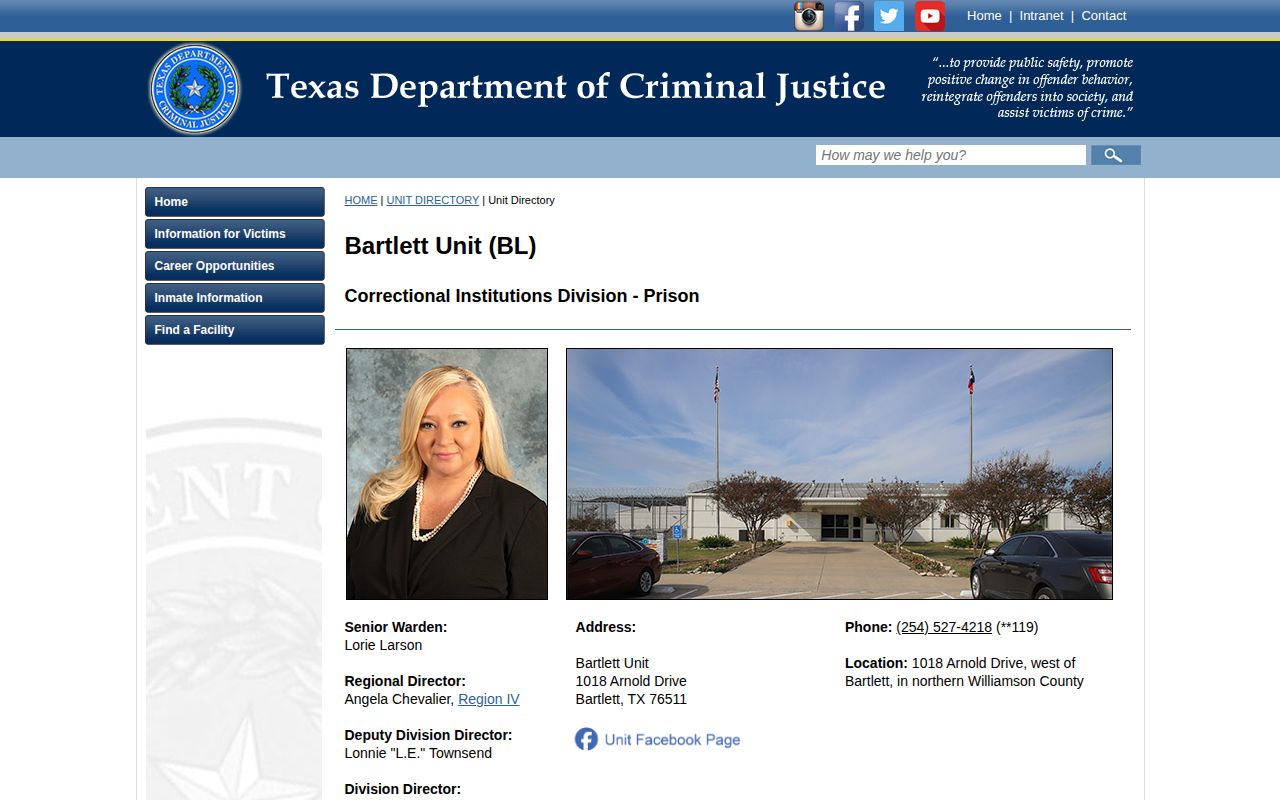
The image confirms that Bartlett Unit is an active TDCJ prison at its current address. It does not establish any individual’s custody or release. That determination still belongs to the matching offender record and TDCJ’s later status.
TDCJ lists the unit as established or on line in October 1995, male, with a capacity of 1,049 and G1 to G2, transient, and restrictive-custody functions. Its directory also lists ambulatory medical, dental, and mental-health capability and pre-release programming. These facility facts do not guarantee a person’s placement, program completion, date, or release route.
Note: Current TDCJ records control Bartlett Unit status; an older closure page cannot prove that a present offender record is historical.
Bartlett Unit Records and Contact
The facility contact confirms Bartlett-specific operational information, while TDCJ’s statewide information channels answer offender status and sentence questions. Do not send a county-jail record request to Williamson County for a Bartlett release. The county may document the earlier transfer out of WCSO custody, but TDCJ controls the later prison record.
Bartlett UnitTexas Department of Criminal Justice, Correctional Institutions Division
1018 Arnold Drive
Bartlett, TX 76511
254-527-4218
The TDCJ Inmate Information hub offers online, email, and telephone routes. The no-charge email information service accepts the full name and seven-digit TDCJ number. If the number is unknown, TDCJ asks for the exact date of birth, or approximate age and county of conviction. Request the TDCJ number, current location, current or prior incarceration, offense and court or county, and Projected Release Date.
The basic email service does not provide photographs or Social Security numbers. For a more extensive retained release or discharge record, use the proper TDCJ public-information process. Identify the exact person, sentence, unit, and fields needed. Do not substitute an old Williamson County booking image for a current state-prison image.
Bartlett Unit Post-Release Supervision
A person released on parole or mandatory supervision remains under the TDCJ Parole Division. If the approved residence and assignment are in Williamson County, the Georgetown District Parole Office is the local field-office route. TDCJ lists it at 40121 Industrial Park Circle, Georgetown, TX 78626, with phone 512-863-0756. A release to another county will normally be routed to a different office.
A discharged person may have no TDCJ supervision on that completed sentence. Parole and discharge should not be treated as synonyms. County probation is also different. It is imposed by a court and managed through a Community Supervision and Corrections Department. Williamson County bond supervision is another local system for selected defendants released from county jail while a case remains pending.
The custody boundaries remain firm. TDCJ confirms Bartlett confinement, a transfer within the prison system, parole or mandatory supervision, and sentence discharge. WCSO and Judicial Records confirm a Williamson County Jail episode. BOP and federal court sources address federal criminal custody. ICE addresses immigration detention. VINE and TDCJ IVSS provide notifications, not certified discharge records.
If a person disappears from a Bartlett location result, look for the updated TDCJ unit or status before calling it release. If the record shows parole, verify the actual release action and assigned office. If it shows discharge, preserve the date and category. The complete answer identifies the state transaction, its date, and whether any supervision or new custodian followed.