
Williamson County Supervision Types
Texas uses three separate forms of supervision that often get called parole in casual speech. Parole and mandatory supervision follow a release from Texas Department of Criminal Justice confinement. The Texas Board of Pardons and Paroles makes the release decision, while the TDCJ Parole Division handles field supervision. Probation, formally called community supervision, comes from a court order and is administered locally by a Community Supervision and Corrections Department. A third local track applies to some felony defendants released from Williamson County Jail on surety or personal bond while the charge is still pending.
The legal source matters. A felony charge does not prove that the person entered TDCJ or went on parole. Someone can face a felony case, post bond, and report to Williamson County Post Release Supervision without ever serving a state-prison sentence. In contrast, a person released from Bartlett Unit may be on state parole or mandatory supervision and report to a TDCJ district parole office. The court judgment, jail release transaction, and TDCJ status record separate these paths.
| Type | How it begins | Who administers it | Best verification record |
|---|---|---|---|
| Parole | BPP approves release before sentence discharge | TDCJ Parole Division | TDCJ offender detail and BPP result |
| Mandatory supervision | Eligible TDCJ case reaches the statutory release calculation and receives required approval | TDCJ Parole Division | TDCJ status, release category, and assigned office |
| Probation | A Texas court orders community supervision | Williamson County CSCD | Signed judgment or supervision order |
| Bond supervision | A court releases a defendant on surety or personal bond with monitoring terms | Williamson County Post Release Supervision | Bond order, docket, and local unit confirmation |
Verify Williamson County Release Supervision
Begin with the custody event, not an assumption about the charge. Williamson County Judicial Records and Williamson County Sheriff’s Office cover county-jail custody. TDCJ covers state confinement, parole, and mandatory supervision. Williamson County court and local supervision departments cover probation or bond conditions. This split prevents a common error: treating disappearance from the Williamson County Jail inquiry as proof of parole.
- Match the person in Williamson County Judicial Records by full name and, when known, booking number or cause number. Read the docket for a bond, judgment, sentence, dismissal, probation order, or transfer.
- If Williamson County record shows transfer to TDCJ, search the TDCJ offender search. Match the TDCJ or SID number, offense, county, age, location, and status before relying on the result.
- For parole review, check the displayed review information and use the BPP results route or status line. A favorable vote can still require a plan, program, conditions, and release certificate.
- For probation, obtain the signed Williamson County court order and contact Adult Probation or CSCD. For a pending felony case after bond, use the Post Release Supervision unit instead.
- Confirm which field office has the case. A person convicted in Williamson County may live and report elsewhere, so the Georgetown office is not automatic.
The full county-jail release transaction can be checked through the Williamson County released-inmate search path when the docket does not show the physical book-out time or receiving agency.
Note: Record the date of every search because custody, warrants, office assignments, and supervision status can change after the initial release.
Williamson County Parole Review Records
Texas does not hold a formal public hearing for each parole or mandatory-release review. The Board of Pardons and Paroles says panel members review and vote on files individually, so there is no public hearing-room calendar to search. The process is case-based. Parole Division generally identifies a person before the initial eligibility point or a later review, an institutional parole officer interviews the prisoner, and a three-member panel votes in sequence. Two matching votes decide the result.
Eligibility is only the first lawful point at which review may occur. It is not a promise of approval or release. Government Code Sections 508.145 and 508.149, along with offense and finding rules in Code of Criminal Procedure Article 42A.054, can affect the date and the availability of mandatory supervision. Current vote codes should be read through the BPP voting-options page. An FI code is favorable further investigation and may still require a program or period. NR is a denial with a later review, while Serve All affects confinement through the applicable sentence timing.
The official parole review sequence shows why the review date, vote, release processing, and actual departure must not be collapsed into one event.
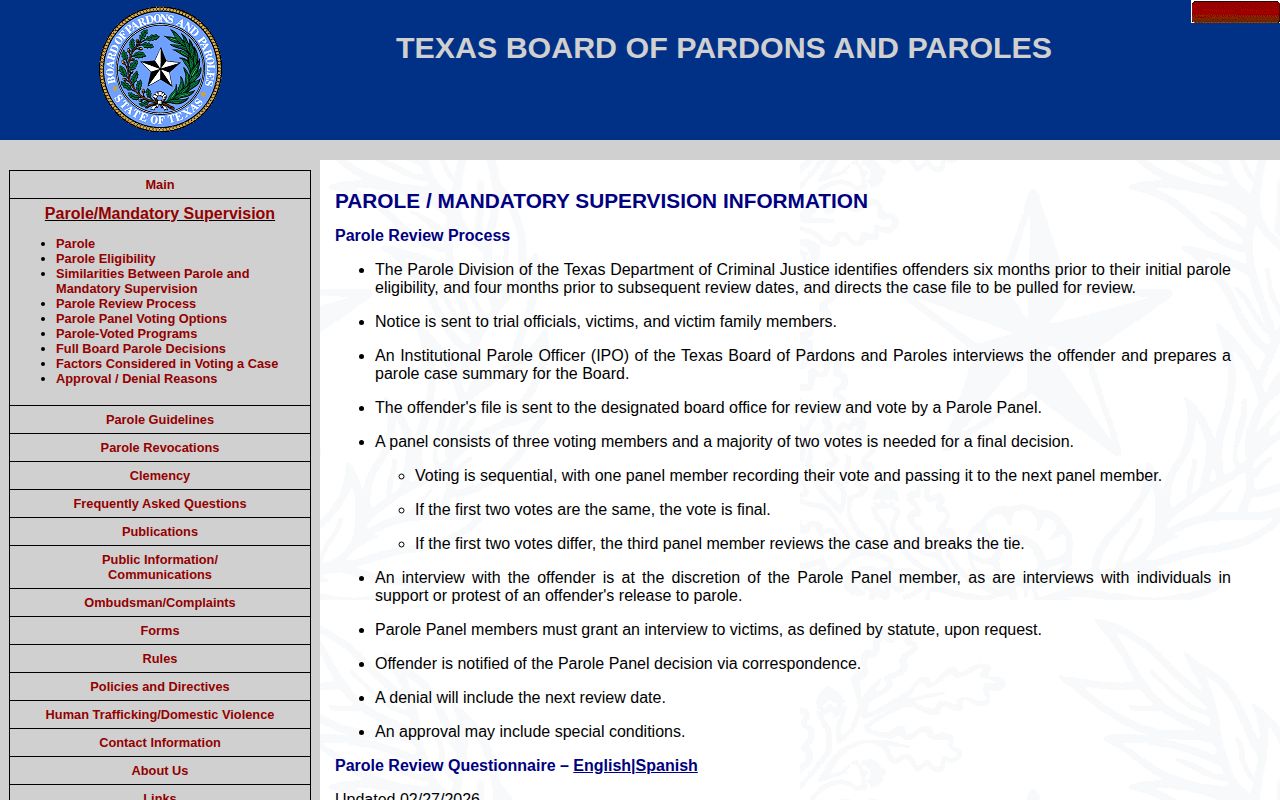
The captured official page provides process context, but the individual TDCJ record and final release transaction control a person-specific conclusion.
Note: A favorable parole vote starts release processing; it does not establish the date when the person physically leaves TDCJ custody.
Williamson County Parole Office
The Georgetown District Parole Office is the local TDCJ field office listed for Region IV. It is the appropriate office route for a person whose approved parole or mandatory-supervision assignment is in Williamson County. Staff can verify routing and reporting instructions within lawful disclosure limits. They may not provide private details to an unrelated caller. If the approved residence is in another county, a different district office can supervise the case even when the conviction or former prison was in Williamson County.
Georgetown District Parole Office
40121 Industrial Park Circle
Georgetown, TX 78626
512-863-0756
Fax: 512-863-4574
The official Georgetown DPO listing is the source for current location and phone information.
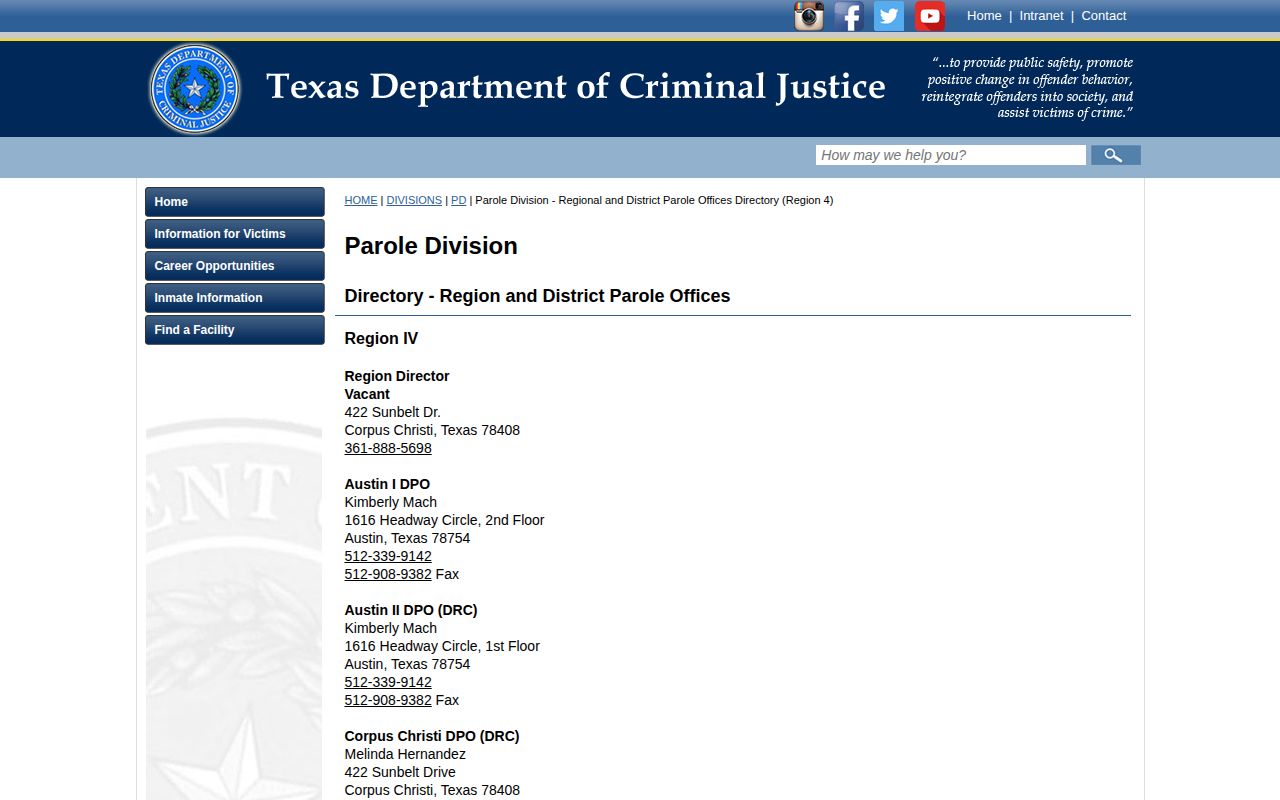
This listing ties the statewide parole record to the local office, but it does not prove that every Williamson County case is assigned there.
Williamson County Bond Supervision
Williamson County publishes a distinct Post Release Supervision program within Pretrial Services. It monitors certain people arrested on felony charges and released on surety or personal bond. The criminal case remains pending. The unit may send court-date reminders and administer monitoring ordered by the court, including ignition interlock, portable alcohol monitoring, SCRAM, or location monitoring. These duties arise from a bond and court order, not a BPP parole vote.
Pretrial Services is located at 405 Martin Luther King Street in Georgetown and lists 512-943-3224. Adult Probation, reached through the Williamson County directory at 512-943-3322, handles court-ordered community supervision after judgment. When the record is unclear, obtain the signed bond, judgment, or supervision order first. Then contact the named department. A Williamson County Sheriff’s Office book-out proves the Williamson County Jail processed the person out, while the court order explains what duties followed.
Note: A person may be out of jail and still have strict court terms, but that fact alone does not make the person a parolee.
Correct Williamson County Release Records
Williamson County provides an unusually direct correction route when the issue is Williamson County Jail record rather than the supervision order. The Sheriff’s Public Records Center identifies incarceration verification as a telephone service. Call the general sheriff line and use the records option described on the live page. Ask staff to distinguish a community release from transfer to TDCJ, another county, USMS, or ICE. A transfer ends Williamson County Sheriff’s Office custody but does not show freedom from all custody.
If a book-out date, release code, or destination appears wrong, identify the exact booking or SO number. Request the underlying booking sheet and release transaction in writing through the Williamson County Sheriff’s Office public-information channels. Reconcile that transaction with the signed court order and clerk docket. The sheriff can address its custody record, while the District Clerk or County Clerk controls the related court record. A stale notification or third-party copy should not replace either source.
This route serves two aims. It creates a repeatable written record, and it sends a disputed field to the agency that made the entry. The Texas Public Information Act requires a prompt response framework, though it does not guarantee that all records arrive within ten business days.
Williamson County Supervision Violations
A missed report, an alleged violation, a warrant, and a revocation are not synonyms. An absconder is generally a person alleged to have stopped reporting or left supervision without authorization. A warrant can authorize detention. Revocation is the later legal action that removes someone from parole, mandatory supervision, or probation after the required process. A new arrest does not itself prove that supervision has been revoked.
No official public Williamson County parole-absconder list was verified. For state parole, check the current TDCJ and BPP routes and contact the assigned field office. For probation, use the court docket, warrant authority, and Williamson County CSCD. For bond supervision, read the pending case and orders. VINELink can send participating custody-event notices, while TDCJ’s Integrated Victim Services System provides a separate state custody and parole notification layer. Neither notification service is a certified discharge or revocation record.
The Texas DPS Public Sex Offender Registry is relevant only when a person has a legal duty to register. It is not a general Williamson County parole or probation database. A matching registry record can document the registration information displayed by DPS, but absence says nothing about most released people and does not prove that supervision has ended.
Williamson County Supervision Discharge
Supervision ends through the legal action that applies to its type. A TDCJ sentence may discharge at maximum expiration or another recorded endpoint. Parole and mandatory supervision can end when the sentence and supervision obligation are completed, unless another valid case or custody matter remains. Probation ends under the court record, often through completion and a discharge order. Bond supervision ends or changes through action in the pending case. The office that monitored a person is useful, but the controlling state or court record is the durable proof.
These terms keep the final check precise:
- Parole
- Conditional release from TDCJ confinement before the sentence fully discharges, subject to state supervision.
- Probation
- Court-ordered community supervision administered by the local CSCD, often instead of or after confinement.
- Mandatory supervision
- A Texas state-prison release track governed by eligibility, time calculations, and required BPP action.
- Absconder
- A supervision status involving alleged failure to report or remain available, which must be verified through official records.
- Revocation
- Legal removal from supervision after violation proceedings, not merely an accusation or arrest.
- Discharge
- Recorded completion of the sentence or supervision obligation at issue.
A complete Williamson County supervision check therefore ends where it began: identify the custodian, match unique case or correctional numbers, and obtain the record that shows the final legal action.